
Something my mind has returned to over and over again for a good decade+ now is the trend in narrative video games, especially flagship titles from big studios and most especially in the 2010’s, toward forcing the player into “hard choices” that don’t really feel all that hard to me. Think of Skyrim, for example, in which, to advance the main plot past a certain point, you must choose to support either the religiously intolerant imperialists or the racist nativists in Skyrim’s civil war. This is meant to be a serious conundrum, a dilemma that could go either way as you’re forced to choose between two problematic options with no chance of a third choice that avoids lots of death and oppression, the kind of thing that comes down to flipping a coin and then biting a bullet.
The thing is, the choice is only remotely hard if your real-world experience with compromises, bad options, oppressive regimes, and ethical dilemmas doesn’t extend much beyond the pages of a college ethics textbook. I’ve talked to a lot of people about Skyrim in the 15 years it’s been out, and those who side with the Stormcloaks (the nativists) have, without exception, been 1) natural-born citizens of the country in which they live, and 2) white. If I ask anyone else which side they chose, the answer is always, “The Imperials, obviously.” No more than that, because we both know that we both know why it’s so obvious. I exist in this world because my ancestors in the 1930s chose America’s intolerance of us over Germany’s, because the former was possible to survive grappling with, while the latter was not.
Back to Skyrim, if you belong to any kind of marginalized group, the very solid consensus I’ve encountered is that not only does the ethical dilemma not register as a “hard choice,” it doesn’t even register as an ethical dilemma. It’s not about which option makes you a better person in an abstract, theoretical sense. It’s about the fact that you can worship Talos in secret if you have to, but you can’t be Argonian in secret. That’s really all there is to it. Cold, hard logistical reality. When someone asks you if you’d rather be shot in the head or the leg, ethics don’t enter into it.
This next part is going to contain major spoilers for the 2015 adventure game Life Is Strange. You’ve been warned.
Life Is Strange is one of the “hard choice” games I spend the most time thinking about, not because it’s particularly good or bad at presenting dilemmas that feel compelling, but because its blindness toward the true asymmetry of those choices takes the particular shape that it does. If you don’t know, or if you need a refresher, the game’s core mechanic is that Max, the protagonist, has the ability to rewind time. This allows the player to see what the short-term results of every individual dialog and action choice will be before deciding on which one to go with (making the game staggeringly popular with the autistic crowd (hi)), as well as to do things like, say, break down a locked door to access someone’s secrets, then rewind time to before you broke down the door, erasing all evidence of the intrusion while retaining your knowledge of said secrets.
Max’s timefucking abilities are first triggered in an early scene, when she witnesses her childhood best friend Chloe being shot to death in a school bathroom. She rewinds time and pulls the school’s fire alarm before the assault can take place, saving Chloe’s life. This sets the tone for the rest of the game. The intended way for most players to proceed through the story is by constantly trying to puzzle out which choices are the “right” ones. The ones that do the most good, prevent the most harm, or, when harm is unavoidable, to make sure it happens to the people who most arguably deserve it.
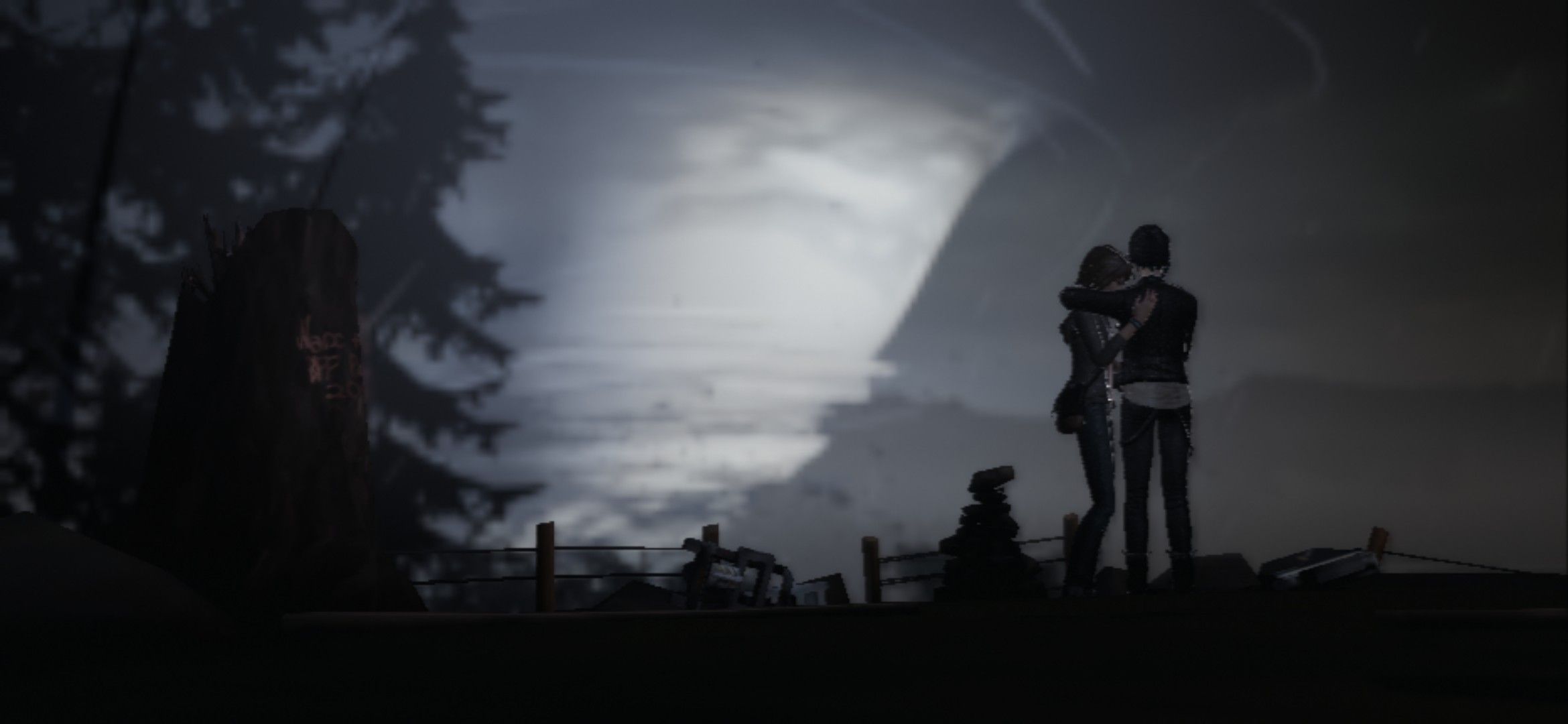
The point of all this is to railroad the player (pun intended) into literally the trolley problem. It turns out that the spacetime distortions created by Max’s constant use of her powers have somehow caused a massive tornado that is going to destroy the town and everyone in it, except for her and Chloe, who happen to be in the one and only safe place in the area when it happens. You are then presented with one final choice: to let this happen, effectively killing every other character, or to rewind time all the way back to the beginning of the story and prevent Max from going into the bathroom where Chloe’s murder takes place. If she doesn’t witness the murder then her powers are never triggered, thus preventing the tornado and saving everyone else, but killing Chloe.
This is the biggest eye-roller of a grand finale I could ever have imagined. For a story that stands so well on its compelling, believable characterization and social dynamics to then, at the end, throw the most ridiculously contrived, logistically hand-wavey scenario possible at you and try to treat it as a masterpiece is something that only an all-bro dev team could get behind. After my first playthrough, I found myself trying to figure out if the game had been a dark comedy the whole time for exactly this reason, an hours-long buildup to a single unbelievable pratfall of a punchline, possibly making it the biggest shaggy dog story in history. After all, even as someone on team spectrum, it would take serious effort for me to take the “butterfly effect” thought experiment so unbelievably literally. So I looked into it, and nope: it was quite serious.
The game works hard to make this a hard choice. The characters feel believable partially because so many of them are such unrepentant shits to Max and everyone else around them. As such, you get moment after moment in which revelations about their pasts, their traumas, their families, attachments, etc. render their actions understandable and sympathetic, to drive home the point that, even for all their flaws, surely they don’t deserve to die, right? And yet, for me, it’s still not a hard choice at all. There I was at the end of the story saying, “Gosh, I dunno, do I save my best friend who I’m gay for, or a bunch of Republicans who were nice to me one time? Oh, wait, I already hit the button lol bye-bye everyone else in town.”
That, at least, was my thinking on my first playthrough, back in 2017 or so. I’ve learned and grown and evolved quite a bit since then. Still, I made the same choice on my last playthrough a couple years back, albeit for very different reasons.
It goes back to the tone set with that first use of Max’s powers. The focus on saving people doesn’t end there, not by a long shot. Max and Chloe’s central focus is on discovering the fate of a missing girl, Chloe’s (perhaps special) friend Rachel Amber, and saving her if she is still alive. There are many smaller, accessory savings and helpings along the way. Regardless of what path the player follows, it is clear that Max’s power is intended to be a source of good deeds of the kind that could perhaps not be done without it, making Max a kind of superhero, albeit not the extrajudicial violence kind. She shoulders the destiny of person after person in the town where the game is set, and is eventually asked to shoulder all of them, including Chloe’s.
I’ve lived long enough to know better than to do this myself. Taking on other people’s karma never ends well, not for you or for them, regardless of what problems you might externally solve in the process. If you don’t know what I’m talking about then you’ll have to take my word for it, because I don’t have the energy to explain it in a blog post, and if you don’t want to believe it then I assure you you’ll always be able to find a what-if or what-about that keeps you able not to.
Even assuming this is the case, I get why Max and Chloe pursue the things they do, and I don’t actually think they’re wrong to do so. Even if they weren’t going around picking up custody of everyone else’s karma, they’d still be stuck in their own, and that’s something that is very much being worked out over the course of the story. There’s a very real sense in which they have to do the things they do, even as destructive as they are, because fucking up is a big part of the price tag attached to self-realization.
But there are going to be consequences.
Part of my theory of storytelling has long been that, once you put a story out into the world, as I do by publishing the ones I write, or as the Life Is Strange devs did by releasing this game, that story comes to belong to those who experience it just as much as it does to those who created it. The ideas in my head are mine. If versions of those ideas make their way into your head – and they will be different versions, no matter how faithful to my original vision my writing might be – those versions are yours. The version of Life Is Strange that exists in my head is mine and, whether or not the devs intended it this way, here is my takeaway from that version’s subtext:
Even if Max went back in time and prevented herself from saving Chloe and using her powers, the tornado would still come. The karmic debt she racked up by taking on everything that happens to everyone in this little down cannot be returned for credit. She can’t put it back. That’s not how it works, time travel or no.
You can’t save everyone, Max. You just can’t. The more you try, the deeper you dig yourself in. Eventually you have to reconcile the weight of it all. That reconciliation might feel like it’s worth it or it might not, but you don’t get to decide to take it or leave it. In the words of Sarah Pinsker, sooner or later everything falls into the sea.
Also, utilitarianism is for kids, in my humble opinion.
I’m the undisputed queen of liking a piece of art for nothing resembling the reasons I’m meant to like it, and Life Is Strange is no exception. It’s on my mind now for no particular reason than because I’m tired of watching my loved ones be so good and just and upright that it kills them (and if you’d like me to expound what I mean by that, you’re going to have to become my very close friend somehow).
Anyway, if you want a game that actually does the whole “hard choices” thing incredibly well, I cannot recommend The Banner Saga parts 1-3 heartily enough.